



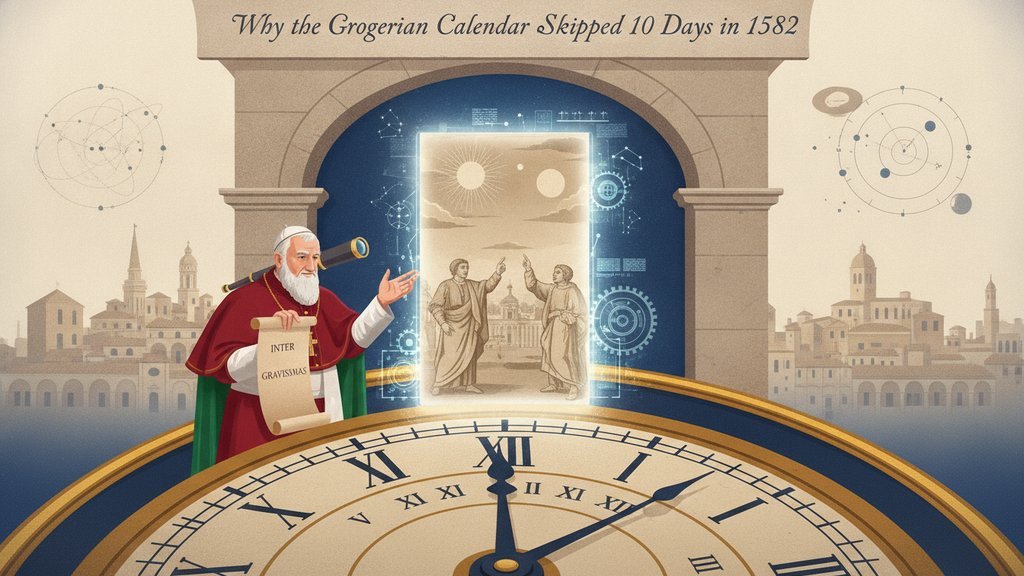
In October 1582, the calendar jumped straight from Thursday the 4th to Friday the 15th, erasing 10 days that simply never happened. The Gregorian calendar skipped those days to correct a slow drift that had built up under the older Julian calendar, which counted slightly too many leap years and had pushed the spring equinox roughly 10 days out of sync with the real solar year. Pope Gregory XIII ordered the fix so that Easter would once again land in its proper season.
Here is the full story of why it happened, how the math worked, and why some countries kept using the "wrong" dates for centuries afterward.
Content Table
The Julian calendar problem
Julius Caesar introduced the Julian calendar in 45 BC. It assumed a year was exactly 365.25 days long, so it added one leap day every four years. Simple, and close, but not perfect.
The actual solar year (the time for Earth to orbit the Sun) is about 365.2422 days. That tiny difference of roughly 11 minutes per year sounds trivial, but it stacks up:
- Julian year: 365.25 days
- Real solar year: 365.2422 days
- Error: about 11 minutes and 14 seconds too long, every single year
- Over 128 years, that adds up to a full extra day
By 1582, more than 1,600 years had passed since the Council of Nicaea in AD 325, which had fixed the spring equinox around March 21 for calculating Easter. All those spare minutes had piled up into roughly 10 lost days, and the equinox was drifting toward March 11.
Why exactly 10 days
The goal was not to undo every mistake since Caesar. It was to reset the calendar to match how things stood at the Council of Nicaea in 325, not the original Julian start in 45 BC.
Astronomers counted the drift that had accumulated between 325 and 1582:
- Time span: about 1,257 years
- Drift rate: roughly one day every 128 years
- Accumulated error: close to 10 days
The papal bull that changed time
On February 24, 1582, Pope Gregory XIII issued a papal bull titled Inter gravissimas ("Among the most serious"). A papal bull is a formal decree from the Pope, and this one ordered the entire Catholic world to fix its calendar.
The bull spelled out the plan:
- Delete 10 days from October 1582
- The day after Thursday, October 4 would be Friday, October 15
- The days of the week stayed in order, so no weekday was skipped, only calendar dates
- Introduce a smarter leap year rule going forward
October was chosen deliberately. It had relatively few major religious feast days, so cutting 10 days caused the least disruption to the church calendar.
What Gregory actually fixed
Deleting 10 days corrected the past drift. But without a new rule, the calendar would just drift again. The real genius of the reform was a tweaked leap year formula that keeps the calendar accurate for thousands of years.
Here is the difference between the two systems:
| Rule | Julian calendar | Gregorian calendar |
|---|---|---|
| Leap year every 4 years | Yes | Yes |
| Century years (1700, 1800, 1900) | Leap years | Not leap years |
| Century years divisible by 400 (1600, 2000) | Leap years | Still leap years |
| Average year length | 365.25 days | 365.2425 days |
That new rule drops three leap days every 400 years. It brings the average calendar year down to 365.2425 days, which is only about 26 seconds off the real solar year. That is accurate enough to stay within one day of the seasons for roughly 3,000 years.
The slow, messy rollout
Only Catholic countries adopted the change in 1582. Italy, Spain, Portugal, and Poland switched right away. But Protestant and Orthodox nations distrusted a decree from the Pope, so they waited, sometimes for a very long time.
- 1582: Italy, Spain, Portugal, Poland, most Catholic states
- 1587: Hungary
- 1700: Protestant Germany, Denmark, and parts of the Netherlands
- 1752: Britain and its colonies, including America, which had to skip 11 days by then
- 1873: Japan
- 1918: Russia, after the revolution
- 1923: Greece, the last major European country to switch
By the time Russia switched, the accumulated gap was 13 days. That is why the "October Revolution" of 1917 actually happened in November by the Gregorian calendar the rest of the world was using.
Proleptic Gregorian dates
Historians and software often need to talk about dates before 1582 (or before a country switched) using Gregorian math. Applying the Gregorian rules to dates earlier than the reform is called the proleptic Gregorian calendar.
This matters a lot for computers. Modern date systems need one consistent set of rules, so most of them quietly ignore the 1582 jump and pretend the Gregorian calendar always existed. This is one reason time handling in code gets tricky, similar to how Unix epoch time counts seconds from a fixed 1970 starting point rather than dealing with messy human calendars, and why long-term time bugs like the Year 2038 problem exist at all.

Test the leap year rule that saved the Gregorian calendar
The 1582 reform introduced the divisible-by-400 leap year rule that keeps our calendar in sync. Check any year instantly to see whether the Gregorian calendar counts it as a leap year.
Check a leap year →
The dates October 5 through October 14, 1582 were removed entirely. Thursday, October 4 was directly followed by Friday, October 15. The days of the week continued in normal order, so only the calendar numbers were skipped, not any weekday in the cycle.
No. The days were only removed from the calendar count, not from real time. Nobody aged 10 days instantly or lost pay. However, contracts, rents, and interest calculations were adjusted so that people paid only for the actual days that passed during that month.
The Julian calendar assumed a year was exactly 365.25 days, adding a leap day every four years. The true solar year is about 365.2422 days, roughly 11 minutes shorter. That small overcount added a full extra day about every 128 years, pushing the equinox off its expected date.
The reform came from a papal bull, so many Protestant and Orthodox nations distrusted it as a Catholic decree. Britain waited until 1752, Russia until 1918, and Greece until 1923. By then the accumulated gap had grown to 11, 13, and 13 days respectively.
It applies the modern Gregorian rules to dates before 1582, when the calendar did not officially exist. Historians and computer systems use it to keep one consistent set of rules across all of history, which avoids the confusion of mixing Julian and Gregorian dates in the same timeline.