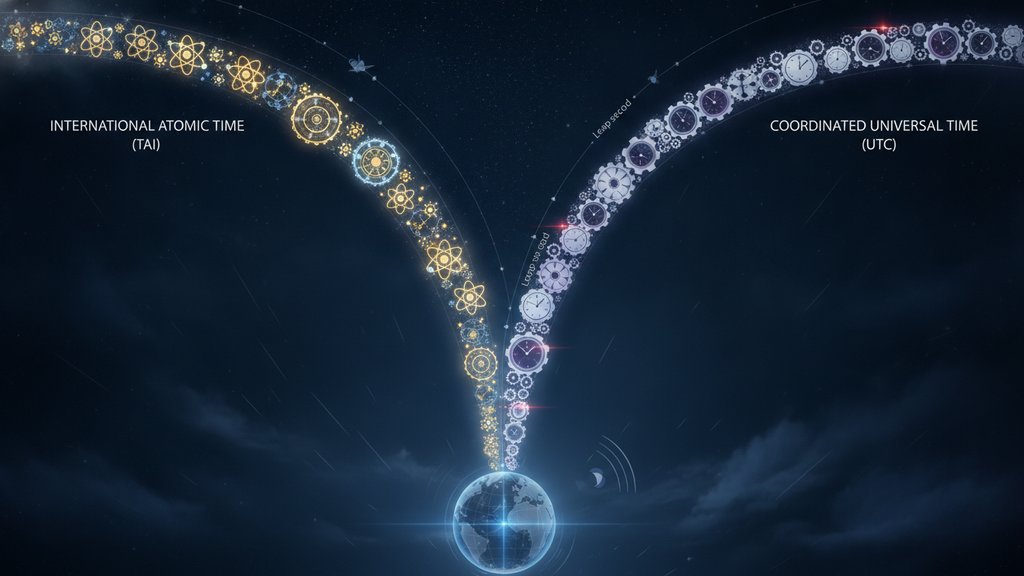
TAI (International Atomic Time) and UTC (Coordinated Universal Time) are both built from the same super-precise atomic clocks, but they don't tell the same time. As of 2024, TAI runs exactly 37 seconds ahead of UTC. The gap exists because TAI is a pure, uninterrupted count of atomic seconds, while UTC gets nudged with occasional leap seconds to stay in step with the Earth's slightly wobbly rotation.
That single design choice, whether or not to pause for the planet, is the whole story behind TAI vs UTC. Below we break down what each one is, why they drift apart, and when you'd actually care as a developer or systems person.
Content Table
What Is TAI Time?
TAI, short for Temps Atomique International (International Atomic Time), is a continuous timescale calculated by averaging the readings of more than 400 atomic clocks spread across roughly 80 laboratories worldwide. The Bureau International des Poids et Mesures (BIPM) in France coordinates all of them and publishes the official result.
The key thing about a TAI clock is that it never stops, never skips, and never repeats a second. It just keeps counting SI seconds one after another, forever. One SI second is defined by 9,192,631,770 oscillations of a cesium-133 atom, which is why atomic time is so stable.
What Is UTC and How It Differs
UTC is the time standard the whole world actually uses for civil timekeeping. Your phone, your servers, and every timezone offset (like UTC+2 or UTC-5) are calculated from it. UTC is built directly on top of atomic time, so its seconds tick at the exact same rate as TAI's seconds.
The difference is that UTC is deliberately kept close to UT1, the timescale based on the actual rotation of the Earth. Because our planet's spin is slightly irregular and generally slowing down, an atomic clock UTC would slowly march ahead of the sun. To prevent that, UTC occasionally inserts a leap second.
- When a leap second is added, a UTC clock shows 23:59:60 before rolling over to 00:00:00.
- Leap seconds are announced by the IERS about six months in advance.
- They are always inserted at the end of June 30 or December 31 (UTC).
Why TAI and UTC Diverge
They diverge for one reason: leap seconds. TAI ignores the Earth entirely. UTC does not. Every time a leap second is added to UTC, the gap between the two grows by exactly one second.
Think of it like two runners going the exact same speed. TAI never pauses. UTC stops for one second every few years to let the Earth's rotation "catch up." After each pause, UTC falls one more second behind TAI, even though both are still running at identical speed.
The 37-Second Gap Explained
When UTC started in its current form in 1972, TAI was already 10 seconds ahead. Since then, 27 leap seconds have been added (all positive, all adding a second). That gives us:
10 (initial 1972 offset)
+ 27 (leap seconds 1972 to 2016)
= 37 seconds

TAI - UTC = 37 seconds (since 1 Jan 2017)
The most recent leap second was added on December 31, 2016. There has not been one since, partly because the Earth has actually been spinning slightly faster in recent years. In fact, the CGPM voted in 2022 to abolish the leap second by 2035, which means the 37-second gap may soon become a permanent, frozen number.
TAI vs UTC Side by Side
| Property | TAI | UTC |
|---|---|---|
| Full name | International Atomic Time | Coordinated Universal Time |
| Second length | SI second (atomic) | SI second (atomic) |
| Leap seconds | Never | Yes (until 2035) |
| Tied to Earth's rotation | No | Yes (within 0.9s of UT1) |
| Used for civil time | No | Yes, everywhere |
| Continuous count | Yes, unbroken | No, has gaps/repeats |
| Current offset | 37s ahead of UTC | Baseline |
When This Matters in Software
For most everyday apps, you never touch TAI. You work in UTC and convert to local time zones for display. A standard Unix timestamp is based on UTC, and honestly, Unix time even fudges the leap second by repeating it, so timestamps stay tidy.
Where the TAI vs UTC distinction becomes real:
- Duration math across a leap second. If you subtract two UTC timestamps that straddle a leap second, you can be off by one second. TAI never has this problem, which is why physics and GPS systems prefer atomic scales.
- GPS time. GPS runs on its own continuous atomic scale that is currently 18 seconds ahead of UTC and 19 seconds behind TAI.
- Financial and scientific logging. Systems that need strictly monotonic, gap-free timestamps sometimes store TAI or a "smeared" version of UTC.
- Distributed systems. Clock sync protocols matter a lot here. If you want to understand how machines agree on the time in the first place, see our guide on NTP time synchronization.
If you are just building web apps and databases, stick with UTC and let the standard libraries handle it. When you convert a raw timestamp into a human-readable date, tools like our Unix timestamp conversion guide assume UTC seconds, not TAI seconds, which is almost always what you want. It also helps to know how epoch time forms the baseline for all of this.

Turn UTC Into Any Local Time in Seconds
Since civil time runs on UTC (not TAI), our timezone converter helps you translate any UTC moment into the exact local time you need, offsets and all.
Try the Timezone Converter →
Frequently Asked Questions
TAI is ahead of UTC. As of 2017 and still true today, TAI runs exactly 37 seconds ahead. This is because UTC has been slowed by 27 leap seconds since 1972, on top of a 10-second offset that already existed when the two scales were aligned.
Yes. Both use the SI second defined by cesium-133 atomic oscillations, so a single second is identical in length on both scales. They only differ because UTC occasionally inserts an extra leap second while TAI never pauses, which shifts their totals apart over time.
Probably not for much longer. The CGPM voted in 2022 to abolish leap seconds by 2035. Once that happens, no new leap seconds will be added, so the offset will freeze at whatever value it holds. It has stayed at 37 seconds since December 2016.
Unix time is based on UTC, not TAI. It counts seconds since January 1, 1970 UTC, but it handles leap seconds by repeating the same value rather than inserting 23:59:60. That keeps timestamps simple, though it means Unix time is not a perfectly continuous atomic count.
GPS time is its own continuous atomic scale started in 1980. It ignores leap seconds like TAI does. Currently GPS time is 18 seconds ahead of UTC and 19 seconds behind TAI, since TAI is fixed at exactly 19 seconds ahead of GPS time.